


Digital Twins for Leaders
Digital twins - mathematical models of physical systems - are one of the most powerful emerging AI technologies. By enabling organisations to simulate complex products or processes before committing the resources required to make real-world prototypes, digital twins can cut costs, accelerate innovation, and reduce environmental impacts. They have applications in almost every field (from engineering and energy to pharmaceuticals and healthcare). However, successful deployment requires not only strong technical teams, but also leaders who take the right strategic approach.
What is a Digital Twin?
Digital twins can be very simple. For example, a single computer chip linked to a sensor in a pipe, running an equation to set off an alert when a water tank is about to overflow, is a basic digital twin. It uses data and a mathematical model to simulate what is going on in the tank and visualise this for users.
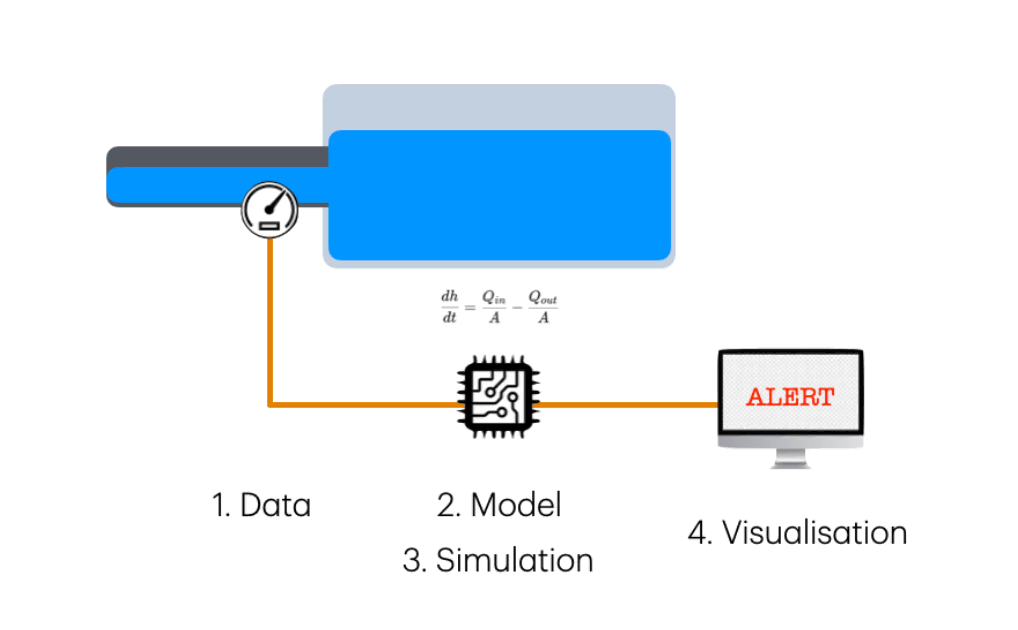
Although many digital twins are far more complex than this, they all have the same four elements:
- Data: collected from sensors (e.g. the one in the pipe) or pre-existing datasets (e.g. the dimensions of the tank).
- Model: equations or algorithms that express the relationship between inputs and results (e.g. the equation linking the volume of the tank and the rate of water inflow to when it will overflow).
- Simulation: a computational platform continuously using sensor data to make a prediction using the model (e.g. the software that runs the equation and sets off an alert when the tank is nearly full).
- Visualisation: Dashboards and interfaces that allow engineers, managers, or decision-makers to understand the results of the twin (e.g. the screen showing the alert)
Competitive Advantage in the Age of AI
This simple concept gives rise to exciting use cases across almost every major sector of the economy. Leaders who have mastered the art of leveraging digital twins are already gaining a significant competitive advantage.
To give just a few examples:
For healthcare, Pfizer are using digital twins to predict how compounds will interact with biological systems, reducing reliance on animal testing. Meanwhile, Philips are developing patient-specific digital twins of hearts that let cardiologists simulate treatment outcomes and personalise care plans.
In the energy sector, Siemens are using digital twins for predictive maintenance of power plants, reducing downtime by 10%; they are also using this technology to optimise placement of wind turbines and increase yield.
Turning to aerospace, NASA are simulating deep space missions using digital twins, to anticipate mission failures and ensure that expensive equipment is not wasted.
When it comes to the automotive sector, BMW are running digital twins of automated production lines, significantly reducing planning time; while Volvo are developing vehicle twins to monitor fleet performance and facilitate remote updates.
Digital twins are big in logistics: DHL are running warehouse twins to optimise the routes of robots and the layout of shelves, improving picking efficiency; while Maersk are building digital twins of global shipping routes to improve their resilience in the face of disruption.
In retail, Walmart are using digital twins of shops and refrigeration units to reduce emergency maintenance by 30%.
And digital twins are even improving our cities: Singapore’s Virtual Singapore project is a full-scale city twin for testing traffic flow, energy demand, and disaster response; while Helsinki have also created a city twin to model noise, pollution, and building energy consumption.
Five Secrets Developers Wish Leaders Knew
Despite their enormous potential, poorly implemented digital twins can be expensive and ineffective. Even small digital twin pilots require significant investments in talent, data and architecture, so it is crucial to ensure projects are not derailed by the challenges that digital twin engineers face at every stage of the development process. So how can business leaders reap the benefits of digital twins, without risking expensive project failures?
1. Ask the Right Questions
Returns on investment in digital twin infrastructure are significantly more likely if leaders start with the right questions. Leaders keen to explore digital twins but unsure where to start should ask themselves:
- Where in my organisation are we spending a lot of time or money on prototyping or testing products or processes?
- Where are we under pressure to reduce waste or emissions?
- Where is the length of our innovation cycle holding us back?
- Where are we managing risks that arise from complex systems e.g markets, supply chains, or regulatory environments?
- Where are our operations subject to a high failure rate e.g equipment failure or missed deliveries?
Answers to these questions will give a good indication of where digital twins could generate value for your business, as a foundation for a discussion with expert engineers.
2. Demand effective integration
Unfortunately, many digital twin projects fall down not because of engineering flaws in the twins themselves, but because of a failure to integrate with the company’s wider systems. A twin that cannot exchange data with Enterprise Resource Planning, supply chain platforms, Internet of Things sensors, or design software, risks becoming just an expensive visualisation tool. Leaders should insist on interoperability from the outset, ensuring that twins can both consume and generate data across the enterprise. This means aligning digital twin initiatives with existing data strategies, cloud infrastructure, and integration standards, so the insights generated can actually drive decisions and actions.
3. Invest in security
In their enthusiasm to implement exciting new technologies, technical teams sometimes forget that digital twins often bring together sensitive operational, financial, and even personal data, making them an attractive target for cyberattacks.
As always, breaches are a major business risk. Therefore, it’s essential that leaders treat digital twin environments as critical infrastructure, embedding cybersecurity controls such as identity management, encryption, and network segmentation from the outset, and committing to regular testing and monitoring in alignment with GDPR.
4. Ensure Stakeholder Buy-in
Surprisingly, the most common reason digital twins fail is not technical. Instead, digital twin projects most often fall down due to a lack of trust from the users and the organisation more widely. Experienced employees have good reasons to distrust digital twins, worrying that they will degrade standards or create avoidable errors. For this reason, clear governance is crucial. From the outset, leaders should consider:
- How clearly models express reasoning and uncertainty
- Accountability for input data quality
- Transparency about how digital twins work (they must never be black boxes)
- A collaborative model-design process, bringing together both traditional engineers/experts and digital specialists
- Through-life processes for assessing and validating twins.
5. Choose the Right Partners
Digital twins sit at the intersection of engineering, data, and operations, so multi-disciplinary teams are central to their success. Traditional engineers or specialists who understand the real-world systems being modelled, and data scientists who can model and analyse the systems, must work together closely. While the former group will often come from within your organisation, it can be challenging to choose the latter.
As a guideline, leaders should look for digital twin engineers who can solve problems at every stage of the digital twin engineering process. It is worth asking how they will address these issues:
- Data must be effectively integrated from all the different sources involved; cleaned effectively when it may be unreliable or low quality; and kept secure. Systems must also be able to handle any latency (delay) if data is being collected in real time; and large volumes of data when necessary
- Models should strike a balance between being complex enough to be useful but simple enough to work with limited processing power; draw on an advanced, inter-disciplinary understanding of the real-world system; evolve with the real-world system; and capture uncertainty
- Simulations need to have sufficient computing power; synchronise effectively with live systems; and, where necessary, integrate multiple simulations (if the twin is for an entire system, rather than just one component)
- Information should be displayed clearly and intuitively for non-technical users, and integrate with existing systems in the organisation
Tech Savvy Leaders Unlock Value
Digital twins are no longer a futuristic concept — they are a practical tool already reshaping industries, and giving leaders a powerful way to de-risk decisions by exploring possibilities and testing solutions before committing significant resources.
But, as ever, the technology itself is only part of the story. Leaders must ask the right questions, ensure integration with other systems, invest in adequate security, build trust through effective governance, and partner with the right mix of technical and domain experts. Organisations that approach digital twins as strategic capabilities — rather than isolated experiments — will gain the most from their deployment.
In short, digital twins offer a rare opportunity to cut costs, accelerate innovation, and reduce environmental impact all at the same time. Leaders who seize this opportunity with discipline, vision, and the right partners will not only future-proof their operations, but also gain a lasting competitive advantage.